
Crucify Him!
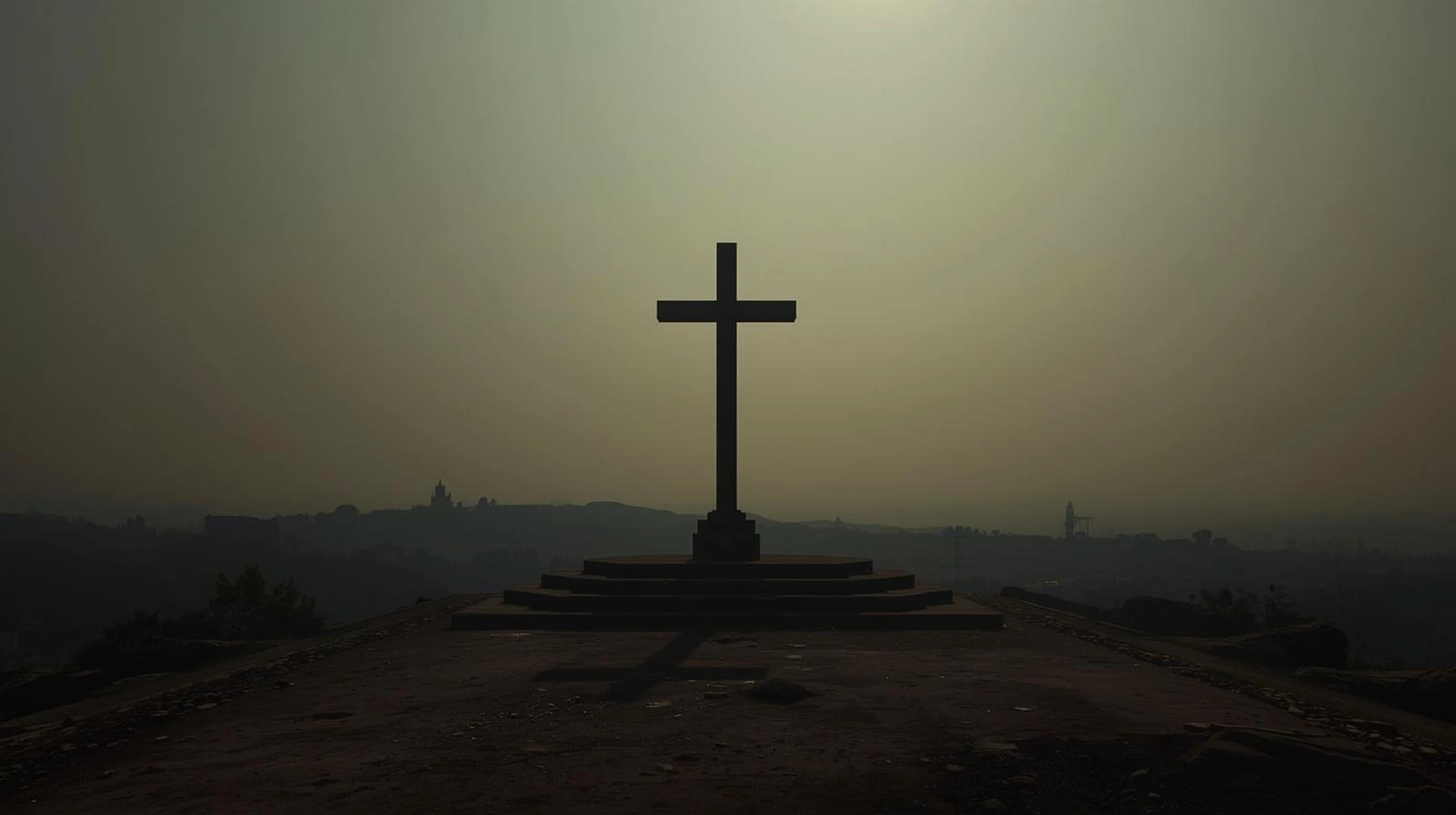
Crucify Him!
Matthew 27:11-31
Today is Resurrection Sunday. We are celebrating the greatest event in human history. It is, in fact, the pivotal moment that divides “before” and “after.” Several weeks ago, Gabriel and I were talking about the account of Cain and Abel. Somehow, our discussion turned to the calendar we use. I commented about BC and AD, and Gabe said something about BCE and CE. He had been told that AD meant “after death,” referring to the death of Jesus.
A quick recap of the way we measure years: BC means “before Christ.” BCE means “before the common era.” AD means “Anno Domini,” in the year of our Lord. And CE means “common era.” But what do they all have in common – whether you acknowledge Christ or not? They all pivot on the life of Christ. The Gregorian calendar measured years from the supposed year of the birth of Christ, year one. But we now know that the calendar makers erred. As we work our way through history, we discover that Herod the Great died in 4 BC, which would mean that Jesus was born one or two years prior, say at least 5 BC. Luke (3:23) tells us that Jesus was about thirty when he began his ministry, which would be no later than AD 25, putting his death and resurrection three years later, no later than AD 28. I say all this to suggest to you that whether or not you are a Christian, you mark the calendar according to the most pivotal person, and the most pivotal event in human history. Everything, whether you choose BCE and CE or BC and AD, dates from the life of Christ. There is no other event, no other person in the history of mankind that influential. The resurrection of Jesus is the dividing line of all of human history.
The apostle Paul goes even further in 1 Corinthians 15 (not our text for today) and suggests that without the resurrection, there is no Christianity, no salvation, no reason for faith, no hope for the future, and no reason for us to gather. When so-called “pastors” or “churches” deny the reality of the physical resurrection of Jesus, the make the case for their own extinction. If Jesus is not risen, they have proven themselves utter fools. For if Jesus did not physically rise from the dead, there is no reason whatever to hold him up as the Christ. In fact, if Jesus did not rise from the dead, he is just another dead man, from a remote backwater village, and no one would have ever even heard of him, let alone considered him of any importance. The fact that we even know of Jesus testifies to the reality of the physical resurrection.
But I’m getting ahead of the story. Even though today is the day to celebrate the resurrection, we need to follow Matthew’s story and complete the journey.
So, let’s go to our text.
There is an important link from the first verse to the last in this section. The Sanhedrin has tried Jesus, found a charge they can hang on him that they think deserves the death penalty. Their problem was that, under Roman rule, the occupied people were not allowed to put someone to death. Rome reserved that right. Roman justice was the rule, no matter what local laws may be. The Jewish charge of blasphemy did not matter to Rome. The only blasphemy they cared about was whether it challenged the authority of the Imperium. And since the Jews couldn’t execute Jesus under Jewish law, they had to hand him over to the Romans for punishment under Roman law.
Now, notice Pilate’s first question to Jesus: “Are you the king of the Jews?” I need to note right here that this was not yet a crime. After all, Rome had allowed puppet kings, and at the moment Herod Antipas, the fifth son of Herod the Great, was king of the Jews. His father, Herod the Great, had been appointed king by Rome. Rome didn’t particularly care about local kings, so long as they were no threat to Rome. If they paid the proper tribute and kept the locals peaceful, tribal kings were useful to Rome. So, we ought to take Pilate’s question as a point of some idle curiosity. It will only matter if Jesus poses a threat to Roman peace and control.
In Matthew we see that Jesus’ only answer, the only thing he says to Pilate is a response to the question, “Are you the king of the Jews?” Jesus’ answer, “You have said so.” Only John reports any other answer. All three, Matthew, Mark, and Luke, report that Jesus stood silent as the chief priests made their accusations. No matter what they said, Jesus did not reply. He did not defend himself. Matthew reports, Jesus made no reply, not even to a single charge – to the great amazement of the governor. “Don’t you hear the testimony they are bringing against you?”
Knowing Matthew’s purposes for his account, we ought to be reminded of Isaiah 53:7 – He was oppressed and afflicted, yet he did not open his mouth; he was led like a lamb to the slaughter, and as a sheep before its shearer is silent, so he did not open his mouth. John reports that Pilate went out to the Jews after questioning Jesus privately and told them, “I find no basis for a charge against him” (Jn 18:38). I will jump ahead in our text to verse 23. As the crowds were shouting for crucifixion, Pilate asked, “Why? What crime has he committed?” What Pilate was telling them is that he found nothing in Jesus that violated Roman law. There was no reason, no crime, no offense that Pilate could use to justify putting Jesus to death. As far as Roman law was concerned, Jesus was completely innocent. That echoes, doesn’t it, Judas’ remorseful statement, “I have betrayed innocent blood” (Mt 27:4)? The supposed crimes against Jewish law did not rise to anything criminal under Roman law.
But Pilate has a much bigger problems on his hands than Jesus’ guilt or innocense. The crowd outside is getting out of hand. A crowd has gathered and is being egged on by Jesus’ enemies. The chief priests want Jesus dead. They can’t get their way legally, so the back-up plan is to start a riot. That will get Pilate’s attention. And Pilate tries to make a deal they shouldn’t be able to refuse.
Whether Pilate initiated the custom or not, it was the custom for the governor to release one prisoner at Passover as a gesture of good will. And Pilate had a really bad criminal in custody awaiting crucifixion. He’d already been tried and convicted. His name was Jesus Bar Abbas. Matthew refers to him as “well-known.” The right word might be “infamous” or “notorious.” Mark (15:7), Luke (23:19), and John (18:40) report that Barabbas had taken part in an insurrection. Mark and Luke report that he was also convicted of murder. What had likely happened is that Barabbas was a ringleader in a revolt against Roman rule that had resulted in the death of at least one Roman soldier. Rome used public crucifixion as a deterrent to rebellion. Barabbas fit the profile, guilty of both insurrection and murder. His crimes made him a menace to the Jews, because his action threatened the peace. Rome had already retaliated harshly for such things. Barabbas was one man you wouldn’t want loose in society. So, I suspect that Pilate thought he had a pretty safe bet. If he offered the Jews a choice between Jesus Bar Abbas, a hardened criminal, murderer, and rebel, and the innocent Jesus of Nazareth, the choice would be an easy one: they would naturally choose to let Jesus go.
But they didn’t. I’m sure it completely took Pilate off guard when the Jews chose Barabbas for release. And he was a man Pilate did not want to let go, and really could not afford to let go. Barabbas posed too great a threat to Roman rule. But Pilate had given his word, and could also not afford to break his word and lose the trust he’d built. So, against his better judgment, he ordered Barabbas to be released.
Now, he had another serious problem: what to do with Jesus, clearly an innocent man. “What will I do, then with Jesus who is called the Messiah?”
“Crucify him!”
“Why? What crime has he committed?”
“Crucify him!"
Pilate was no dummy. He had a riot brewing and only one way out. He had to give in to the demands of the crowd or face a riot. A riot and a heavy-handed Roman response at Passover meant trouble for Pilate in Rome. His position was on the line, and very possibly his own life. So, he declared his own innocence in the situation, released Barabbas, and sent Jesus to be crucified.
Now, here’s where the initial question ties in: Pilate’s soldiers take Jesus into the Roman garrison, the Praetorium, and gathered the whole garrison for a coronation. It is plain that they intended it as mockery, but change the accoutrements, and the ritual is the same. But it was not for a tribal king – it is the elevation of a new emperor. And it gets very interesting as it goes along.
First, civilian clothing is removed and imperial garments are put on, including a purple or scarlet robe. The emperor “ascends” to the purple. Then a crown is placed on his head, usually a crown woven of laurel. Then the imperial scepter is placed into the new emperor’s right hand, held in the crook of his elbow. Having properly attired the new emperor, the soldiers all kneel and acclaim their new emperor, “Hail, Caesar!” shouted and repeated over and over.
Now, look at what the soldiers did to Jesus. They stripped him and laid a scarlet robe over his shoulders. They placed a crown – of thorns – on his head. They placed a scepter – a reed (KJV) or a staff (NIV) – in his right hand. Then they knelt in front of him and mocked, “Hail, king of the Jews!”
The final step is to lead him to the imperial throne. Once he sits on the throne, he is officially the new caesar. But that step is yet to come.
The soldiers had their fun, but then it was time to get serious about their business. They took the staff away from him and began to beat him over the head, causing the crown of thorns to dig more deeply into his scalp, and causing the blood to flow. They spat on him, a sign of ridicule and disgust. Then they stripped off the scarlet robe and put his own clothes back on him. Other gospels reveal more tortures, more beatings, including the use of a flagrum, a particular kind of whip, also called a “scorpion” because of the intense pain it caused. The flagrum would have been similar to a later whip known as a “cat o’ nine,” with multiple leather thongs attached to a handle, and each of the thongs tipped with a shard of bone, pottery, or metal so that it dug into the flesh. It was capable of causing severe injuries, and I will spare you a description. Very often, those punished with the flagrum died from their injuries.
Now, let me put this together. When the high priest turns Jesus over to Pilate, we can assume that he relayed the charges against Jesus. It would be a simple matter to explain to Pilate that Jesus claimed to be the Messiah, and that the meaning of Messiah included both the concepts of priest and king. It may be that they assumed that by accusing Jesus of claiming to be king, he would be a threat to Rome, perhaps on a charge of treason. As I’ve already explained, it didn’t work that way. But, when Pilate asked Jesus if he were the king of the Jews, Jesus’ answer was essentially, “Those are your words.” In other words, “that’s how you interpret what they accuse me of.” Jesus hadn’t said it himself. So, Pilate addresses Jesus as “king of the Jews.”
According to John, Jesus then explains to Pilate what sort of king he is, and what sort of kingdom he rules. That is apparently no threat to Rome and no concern of Rome. Then when Jesus is on the cross, Pilate has the “charges” posted on the cross, so everyone will know why he is being executed. In three languages, Greek, Latin, and Hebrew, the sign read, “King of the Jews.” Not, he claimed to be, but he is. Pilate, with the power of Rome behind him declares that Jesus is king of the Jews.
Then, as I described just a bit ago, the whole garrison of the Praetorium gathered around Jesus and elevated him as emperor. They went through the ritual of installing Jesus as their own ruler. They may have meant it as mockery, but they did it nonetheless.
I tell you this, on this Resurrection Sunday, to tell you that Rome itself declared Jesus to be king. He is the king. He is the Messiah. He is Lord. For Rome, there is one more step, and that is the elevation of Jesus, to lift him up and present him to the world as king. We’re getting ahead of the story, but that’s precisely what they did, as we will see in just a couple weeks. So, on this Resurrection Sunday, we declare Jesus to be our King, our Messiah, our Living Lord. And we bow in worship at his feet.